
Evidence that your AI agents are under control.
AI policies are easy to write and hard to prove. SILO.RED turns what agents actually did into a record you can hand to the board, the auditor and the regulator.
What the board asks, and where the answer comes from.
Which agents are running?
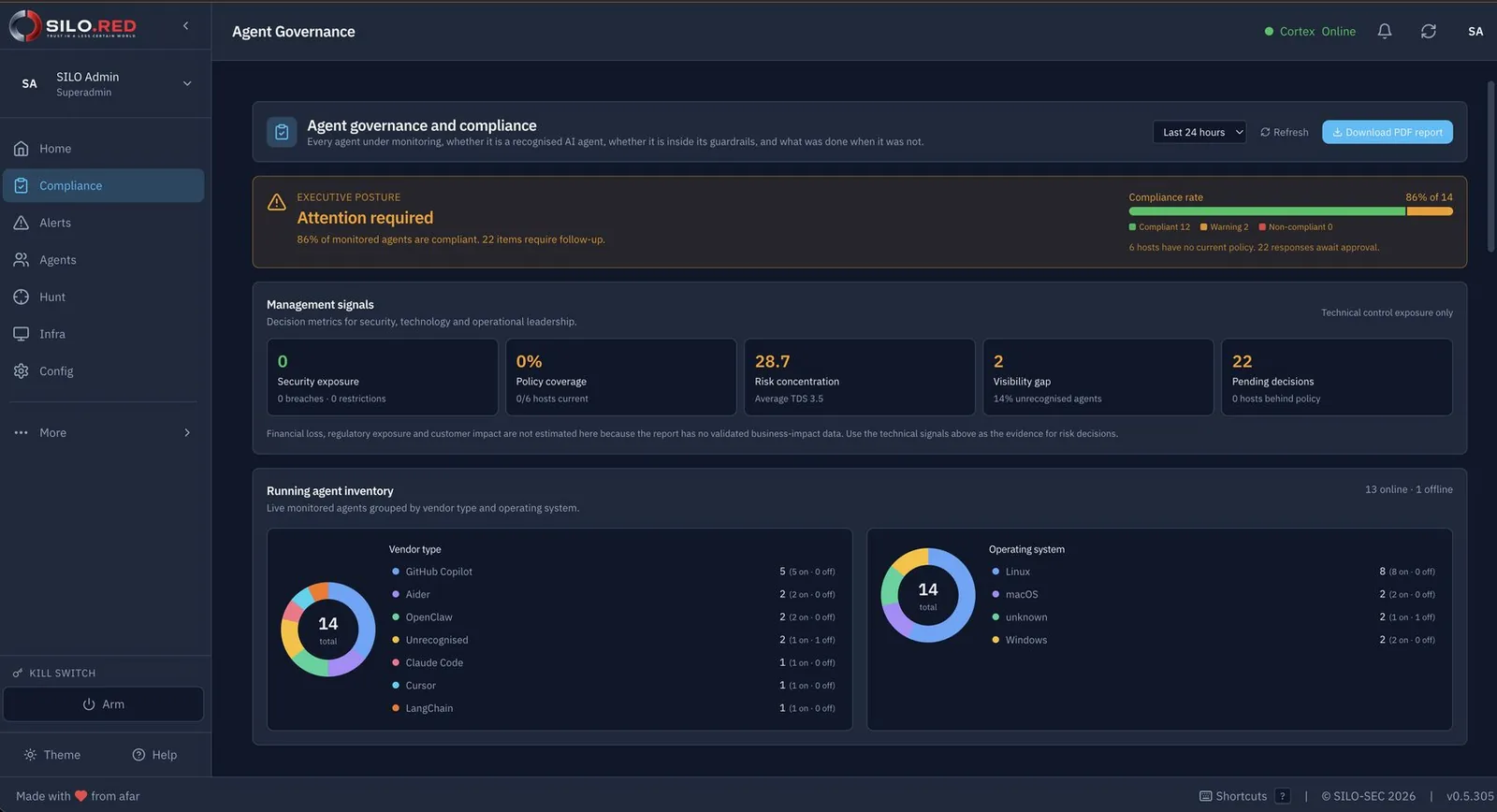
Every agent on every host, by vendor and operating system, including agents nobody registered. An agent is recognised by what it does, not only by its name.
What may each one do?
Rights per agent (files, network destinations, programs it may start, credentials) and guardrails set centrally for the estate, a group or a host.
Is it staying within that?
A compliance status per agent: compliant, warning or non-compliant. Each breach is kept with the rule, the agent, the host and the time.
Who approved the serious actions?
Isolation and termination can be held for a named operator. The approval, the reason and the outcome go into the record together.
Can we prove it?
The record is hash-chained, so an edited or deleted entry is detected. The governance report is built from it, with a PDF in one click.
One record, kept in your estate, that cannot be quietly edited.
- Findings, scores, responses and approvals chained with a keyed hash. A gap or an edit is reported, with where it happened.
- Counts come from the record itself, so a report never shows the length of a capped list as a total.
- A daily snapshot shows the trend, so the board sees direction as well as position.
- Hosts without a current policy are named rather than averaged away.
- Stored on your own infrastructure. Nothing is sent to us.
Where the evidence fits.
Most AI and resilience frameworks ask for the same few things: know what is running, control it, watch it, and keep records. SILO supplies the evidence for that part.
| Framework | What it asks of you | What SILO gives you |
|---|---|---|
| EU AI ActEuropean Union | Record-keeping, human oversight and monitoring of AI systems in use, especially those classed as high-risk. | An inventory of agents in use, a log of what each did, and operator approval recorded for serious interventions. |
| UK and EU GDPR | Accountability, security of processing, and impact assessments where personal data is processed automatically. | Evidence of which agents touched which data and what was done when one stepped outside its rights. |
| DORAEU financial services | ICT risk management, detection of anomalous activity and incident records. | Agents brought inside detection and response, with a tamper-evident incident record. |
| ISO/IEC 42001 | An AI management system: inventory, controls, monitoring and records. | The operational controls and records that the management system points to. |
| NIST AI RMF | Govern, map, measure and manage AI risk. | Map: the inventory. Measure: per-agent scores. Manage: proportionate responses and approvals. |
| MAS guidelinesSingapore | Technology risk management, and oversight of AI used by financial institutions. | Monitoring and audit trails for AI agents on the institution’s own infrastructure. |
| FCA and PRAUnited Kingdom | Senior managers’ accountability, Consumer Duty and operational resilience. | A record a senior manager can rely on, showing that agents in customer and operational processes are controlled. |
SILO does not make an organisation compliant with any of these; it supplies evidence for the controls they describe. The mapping is a guide. Your own advisers decide what a framework requires of you.
The moments when someone asks for proof.
A supervisory letter
A regulator asks how AI is controlled, or an AI Act, DORA or MAS review comes round.
An audit finding
Internal audit raises AI, or the AI governance committee will not approve a use case.
A questionnaire
A customer’s security or AI questionnaire asks something the business cannot answer.
An incident elsewhere
An agent at a peer or supplier does something it should not have, and the board asks whether it could happen here.
See the report built from your own estate.
A design partnership starts with a few machines and ends with a governance report you can take to the board.